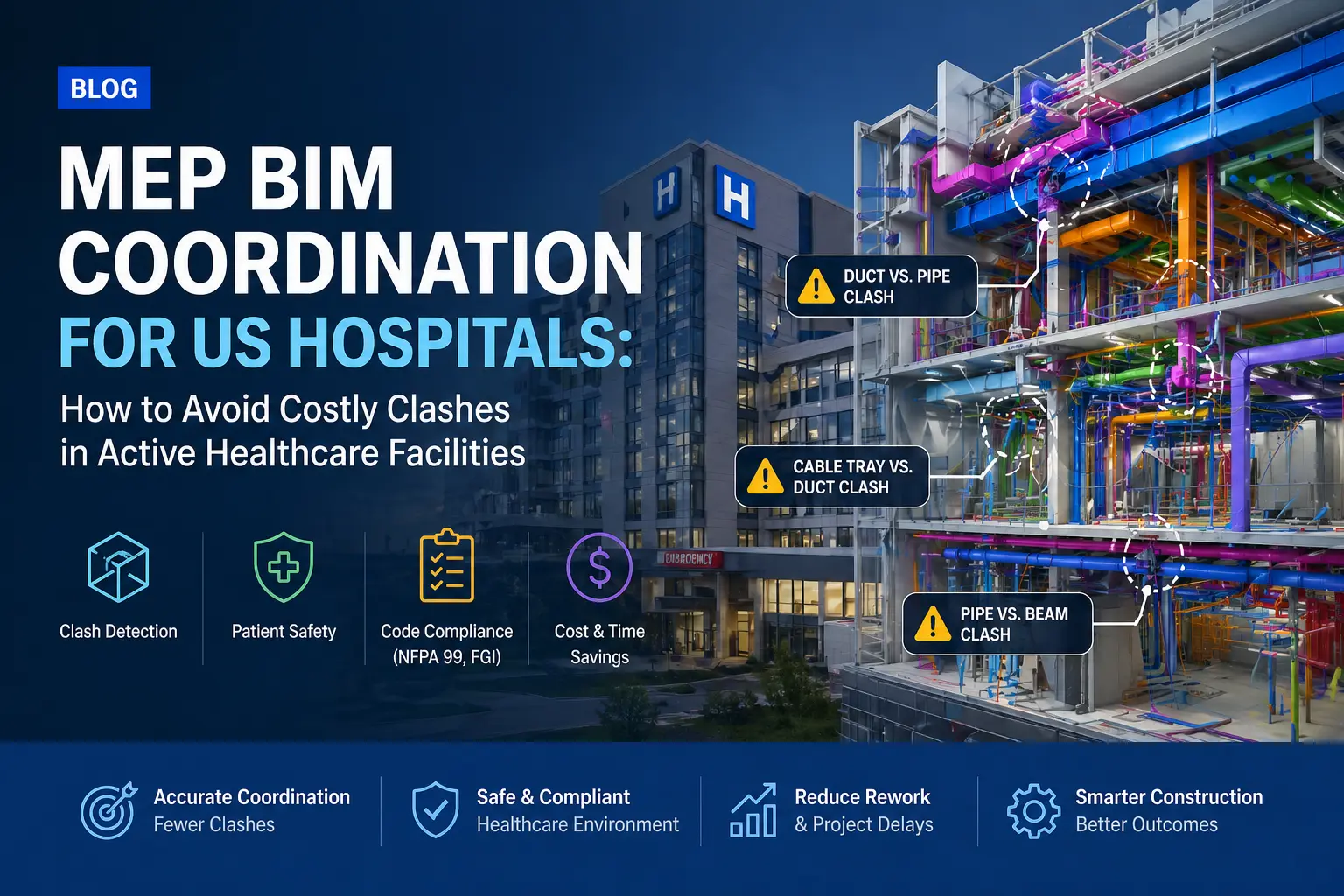
If you've ever managed MEP work inside a live hospital, you already know — it's a different world compared to any other construction project.
Nurses are walking the same corridors where your crew is running ductwork. ICUs are two floors above your mechanical room install. A single fire alarm triggered by dust from a core drill can evacuate a wing and cost the hospital thousands of dollars in disrupted patient care. There's simply no room for the kind of errors that might be tolerable on a commercial office build.
That's exactly why MEP BIM coordination has become non-negotiable for US hospital projects — whether it's a full new build, a wing renovation, or upgrading an aging mechanical system while the facility stays operational.
This guide breaks down what MEP BIM coordination looks like in a real hospital environment, why clashes are so expensive in healthcare settings, and what US contractors need to know before taking on this work in 2026.
What Makes Hospital MEP So Much More Complex Than Other Buildings?
Walk through the MEP drawings of a modern US hospital and compare them to a commercial office building of similar square footage. The difference is immediate.
Hospitals pack more systems into tighter spaces than almost any other building type. You've got HVAC ductwork for general ventilation alongside dedicated negative-pressure exhaust for isolation rooms. Medical gas lines — oxygen, vacuum, nitrous oxide — running through walls and ceilings alongside electrical conduits and plumbing. Emergency power feeds that have to stay live 24/7. Nurse call systems, fire protection, and specialty systems for operating theaters and radiology.
And all of these systems have to coexist, often in ceiling spaces and wall cavities that are already crowded.
In a regular commercial building, a clash between an HVAC duct and a pipe run is an inconvenience. In a hospital, the same clash — if discovered during construction — can mean rerouting systems that run through active clinical zones, triggering infection control requirements, and potentially shutting down part of the facility.
The stakes are simply higher. Here is a quick comparison:
| Factor | Commercial Office | Active Hospital |
|---|---|---|
| Rework tolerance | Moderate | Near zero |
| System density | Standard | Very high (HVAC + medical gas + electrical + plumbing) |
| Infection control during construction | Not required | Mandatory (ICRA protocols) |
| Downtime cost of a clash | Low | Very high (patient safety risk) |
| Regulatory compliance | Standard codes | NFPA 99, FGI Guidelines, ASHRAE 170 |
| Work around active operations | Rarely needed | Almost always required |
Why Clashes in Hospital MEP Are So Expensive
A clash in construction is when two building components occupy the same physical space — or come close enough to violate clearance requirements. In MEP work, this usually means a duct running into a pipe, a cable tray blocking access to a valve, or a medical gas line too close to an electrical panel.
The construction industry already knows rework is expensive. Studies consistently show that rework can account for anywhere from 5% to 30% of total project costs depending on project type. But in hospitals, that number can go even higher — and the consequences extend beyond dollars.
Here is why clashes cost more in healthcare settings:
1. You cannot just pause the building to fix it.
In a new build, discovering a clash mid-construction means stopping that section of work, redesigning the affected systems, and reordering materials. Painful, but manageable. In an active hospital renovation, you may have to shut down a corridor that serves an occupied ward, coordinate with infection control, move temporary barriers, and re-sequence entire trades.
2. Healthcare systems have zero redundancy tolerance.
If your crew accidentally cuts a medical gas line or damages an emergency power conduit, you are not just causing a delay — you are creating a patient safety event. Hospitals carry serious liability around this, and the documentation requirements for incidents in healthcare facilities are far more extensive than commercial work.
3. The cost per incident is high.
Resolving a hard clash discovered on-site — where two elements literally occupy the same space — typically costs upward of $5,000 per incident just in labor and material reordering. In a dense hospital MEP environment where hundreds of systems intersect, even a small percentage of clashes making it to the field can easily push rework costs into the hundreds of thousands. One well-documented hospital project identified over 200 MEP clashes during BIM coordination — resolving them virtually saved an estimated $1.5 million in potential field rework.
How MEP BIM Coordination Works in a Hospital Environment
BIM coordination for hospital MEP is not just building a 3D model. It is a structured process that typically spans from preconstruction through to installation, and it involves several disciplines working inside a shared digital model.
Here is how it generally unfolds on a US hospital project:
Step 1: Federated Model Setup
The MEP BIM coordinator brings together separate models from all the relevant trades — architectural, structural, mechanical (HVAC), electrical, plumbing, fire protection, and medical gas — into a single federated model using tools like Autodesk Navisworks or Revit. This is the single source of truth for the entire project team.
Step 2: Clash Detection Runs
Using Navisworks or similar software, the BIM team runs automated clash detection across all discipline combinations. This flags hard clashes (two objects occupying the same space), soft clashes (clearance violations, like an electrical panel without the required NEC 36-inch working space), and workflow clashes (sequencing conflicts between trades).
For hospitals, the clash matrix is more extensive than a standard commercial project. You are checking HVAC against structural, medical gas against electrical, plumbing against fire protection, and so on.
Step 3: Coordination Meetings
Clash reports are shared with all trade subcontractors, and weekly coordination meetings are held to work through priority issues. In a hospital environment, the coordination team also has to factor in infection control constraints — certain areas of the building may be restricted based on ICRA (Infection Control Risk Assessment) protocols, limiting when and where construction activities can occur.
Step 4: Model Updates and Recheck
After clashes are resolved, the models are updated and another clash detection run is performed. This cycle continues until the model is clean — meaning all identified conflicts have been resolved in the virtual environment before anyone picks up a tool in the field.
Step 5: Construction-Ready Deliverables
The final coordinated model is used to produce shop drawings, spool drawings for prefabricated MEP assemblies, sleeve and penetration drawings for structural openings, and installation sequencing plans. For hospital projects, these deliverables also need to align with phasing plans that keep active clinical areas protected throughout construction.
The Four MEP Systems That Need the Most Attention in Hospitals
Not all systems require the same coordination effort. In hospital projects, four areas consistently produce the highest density of clashes and the most complex coordination requirements:
HVAC and Infection Control Ventilation
Hospital HVAC is not a standard comfort system. Different areas of the hospital require completely different air handling strategies — and they have to be physically separated.
Operating rooms and clean rooms typically require positive pressure and HEPA filtration. Isolation rooms for infectious patients require negative pressure, pulling air away from corridors. ICUs have their own air change rate requirements. The airflow relationships between these spaces have to be precisely modeled and coordinated, because a duct running to the wrong pressure zone can compromise infection control.
ASHRAE Standard 170 (Ventilation of Health Care Facilities) and the FGI Guidelines set the specific requirements for each room type. Any MEP BIM coordinator working on a US hospital needs to be familiar with both.
Electrical and Emergency Power Systems
Hospitals operate on a life safety electrical system that goes beyond standard building codes. The National Electrical Code (NEC), specifically Article 517, defines requirements for healthcare facilities — including how essential electrical system (EES) circuits are classified, how emergency power distribution is designed, and what redundancy is required.
In BIM terms, this means modeling multiple electrical distribution paths — normal power, emergency power, and critical branch circuits — and coordinating them through a building where conduit routing space is already limited by HVAC, plumbing, and medical gas systems.
Plumbing and Medical Gas
Hospital plumbing goes beyond domestic water and waste. Medical gas systems — oxygen, medical air, vacuum, nitrous oxide — are regulated under NFPA 99 (Health Care Facilities Code) and require their own zone valve arrangements, alarm systems, and separation requirements from other utilities.
In BIM coordination, medical gas is often one of the trickiest systems to route because it has strict separation requirements from electrical panels and certain HVAC equipment, while also needing to be accessible for maintenance. Coordinating these runs through a federated model catches routing conflicts before they become field problems.
Fire Protection
Hospital fire protection follows NFPA 13 for sprinkler systems, but healthcare facilities have additional requirements around fire compartmentalization, smoke barriers, and smoke exhaust systems. Fire protection modeling in a hospital BIM environment needs to account for the building's smoke compartment layout, which directly affects where heads can be placed and how mains are routed.
Fire protection is also often the last trade modeled — which means it tends to inherit the tightest remaining spaces in an already-crowded ceiling. Good BIM coordination allocates ceiling space for fire protection early, rather than trying to squeeze it in at the end.
Working Around Active Hospital Operations: What Contractors Need to Know
About 65% of US healthcare construction projects are renovations rather than new builds. That means most hospital MEP work is happening inside — or immediately adjacent to — occupied, operating facilities.
This changes everything about how coordination works.
ICRA Protocols dictate your work zones.
The Infection Control Risk Assessment (ICRA) process categorizes construction activities by their potential to generate dust, vibration, or airborne contaminants. Depending on the ICRA classification of your work, you may need sealed construction barriers with dedicated exhausted air supply, air pressure differential between the construction zone and the hospital, HEPA filtration, and daily inspection logs. Your MEP BIM model needs to account for these zone boundaries — routing work through active areas requires different phasing than work confined to shut-down zones.
Phased shutdown planning is mandatory.
You cannot just shut down an HVAC system that serves occupied wards. Tie-ins and transitions have to happen during scheduled maintenance windows — often nights or weekends — and temporary systems need to be in place to maintain operations. BIM 4D sequencing (attaching time-based data to the model) helps map out these phased shutdowns before construction starts, reducing last-minute surprises.
Noise and vibration control matters.
Core drilling, pipe cutting, and duct installation produce noise and vibration that can disrupt patient care, interfere with sensitive medical equipment, and even trigger smoke detectors. BIM coordination helps identify the proximity of sensitive areas — MRI rooms, ICUs, operating theaters — so those activities can be scheduled appropriately.
What LOD Level Does a Hospital MEP BIM Model Need?
Level of Detail (LOD) in BIM defines how much information and geometric accuracy is included in a model at each project stage. For hospital MEP coordination, the typical requirements are:
- LOD 300 — Coordination and documentation. Enough detail to identify clashes, produce coordination drawings, and support permit submissions. Most hospital design-phase models are developed to LOD 300.
- LOD 400 — Fabrication-ready. Includes exact dimensions, fittings, hangers, and connection details. Required for prefabricated MEP assemblies and spool drawings. Hospital projects using prefab MEP racks typically require LOD 400 for mechanical and plumbing systems.
- LOD 500 — As-built. The model updated to reflect exactly what was installed. Required for hospital facility management and future renovation work.
The LOD requirement for your hospital project should be defined in the BIM Execution Plan (BEP) agreed upon at project kickoff. If your project does not have a BEP, that is a gap worth addressing early — it prevents scope disputes later between the BIM coordinator and the trade subs.
The Role of Prefabrication in Hospital MEP (and Why BIM Enables It)
Prefabricated MEP assemblies have become standard practice on US hospital projects in 2026 — and for good reason.
In an active hospital environment, every hour of on-site labor in a restricted clinical zone carries risk and cost. Prefabricating MEP corridor racks, bathroom pods, and in-wall rough-in assemblies off-site — in a controlled factory environment — shifts the bulk of labor away from the hospital floor, reduces dust and noise in clinical areas, and speeds up installation significantly.
But prefab only works when the BIM model is accurate enough to manufacture from. If the dimensions in the model do not precisely reflect site conditions — including existing structure, slab-to-slab heights, and the positions of other services — the prefabricated assemblies will not fit when they arrive on site.
This is why LOD 400 BIM coordination is the foundation of any hospital prefab strategy. The model has to be right before the first piece is cut.
A well-coordinated LOD 400 hospital model does not just prevent clashes. It becomes the fabrication document.
Common Mistakes in Hospital MEP BIM Coordination
Even experienced contractors make these errors on healthcare projects. Worth knowing before you start:
Starting coordination too late. BIM coordination needs to begin at the design development stage, not after construction documents are issued. By the time CDs are complete, structural penetrations may already be planned in locations that create downstream MEP conflicts.
Not including medical gas in the federated model. Medical gas is often handled by a specialty subcontractor who does not initially participate in BIM coordination. When medical gas routing is not modeled, the clashes with electrical and plumbing systems only appear in the field.
Skipping ICRA zone mapping in the BIM model. The BIM model should reflect the infection control zoning of the project. Without it, phasing decisions get made in isolation, and work ends up scheduled in ways that violate ICRA protocols.
Treating BIM coordination as a one-time exercise. Hospital projects have a high rate of design change. BIM models need to be updated as design evolves, with clash detection re-run after every significant revision. A model that was clean at the start of construction will not stay clean through three rounds of design changes.
Not planning ceiling space for all trades from the beginning. In hospital corridors and patient rooms, ceiling space is extremely limited. If the BIM coordinator does not allocate space for all systems — including fire protection — from the earliest coordination meetings, one trade will inevitably be left with no viable routing path.
Why US Healthcare Contractors Are Outsourcing MEP BIM Coordination
Running a full-time in-house BIM coordination team requires Revit-certified modelers, Navisworks specialists, and experienced VDC managers who understand healthcare construction. For most MEP subcontractors and general contractors, that is a significant overhead cost — especially when hospital projects are a portion of their overall portfolio rather than their core business.
Outsourcing MEP BIM coordination to a specialist firm gives contractors access to a dedicated team with healthcare-specific BIM experience, without the burden of software licensing, training costs, and staff retention. It also means the coordination deliverables — clash reports, shop drawings, prefab layouts — are produced by people who do this every day on hospital projects, not a general modeler adapting to an unfamiliar building type.
For US contractors running active hospital renovation projects in 2026, where MEP labor shortages are already stretching internal capacity, outsourcing BIM coordination is increasingly the practical choice.
Key Codes and Standards for Hospital MEP in the USA
Any MEP BIM coordinator working on US healthcare projects needs to be working to these standards:
- ASHRAE 170 — Ventilation of Health Care Facilities. Defines air change rates, pressure relationships, filtration requirements, and humidity ranges for every room type.
- FGI Guidelines — Facility Guidelines Institute. The primary reference for healthcare facility design in the US, covering space requirements, MEP system requirements, and infection control design.
- NFPA 99 — Health Care Facilities Code. Covers medical gas systems, electrical system requirements, and emergency power.
- NFPA 13 — Installation of Sprinkler Systems. Applies to fire protection design throughout the facility.
- NEC Article 517 — Electrical requirements specifically for healthcare facilities, including essential electrical system classification and distribution requirements.
- The Joint Commission standards — Covers life safety requirements that directly affect MEP system design and operation for accredited facilities.
Frequently Asked Questions
MEP BIM coordination for hospitals is the process of creating and coordinating 3D digital models of all mechanical, electrical, plumbing, fire protection, and medical gas systems within a hospital building. The goal is to identify and resolve clashes between systems before construction starts, so that field installation runs smoothly without costly rework or disruption to active clinical operations.
Hospitals have a higher density of MEP systems than almost any other building type, combined with strict regulatory requirements, infection control protocols, and the challenge of working around active patient care. A clash discovered in the field carries far higher consequences — in cost, time, and patient safety risk — than in a commercial building, making upfront virtual coordination essential.
The most common tools are Autodesk Revit for discipline-specific 3D modeling, Autodesk Navisworks for federated model clash detection and coordination, and Revizto or Autodesk Construction Cloud for issue tracking and field communication. Some teams also use Solibri for compliance-based model checking.
Most hospital coordination models are developed to LOD 300 for design coordination and LOD 400 for fabrication-ready deliverables. LOD 500 as-built models are typically required for facility management and future renovation work.
For complex healthcare facilities, MEP BIM coordination typically ranges from $5 to $15 per square foot depending on system complexity, LOD requirements, and the extent of coordination services included. A highly specialized facility like an operating suite or ICU wing will sit at the higher end of that range. Getting an accurate quote requires a project-specific scope review.
Yes — in fact, it is especially valuable for renovations of active hospitals. BIM coordination for renovations typically starts with an as-built model of existing conditions (often built from 3D laser scan data), which is then used as the baseline for modeling new MEP systems. This ensures that new work accurately reflects what is actually in the building, not what the original drawings show.
Working With a MEP BIM Specialist on Your Hospital Project
Getting MEP BIM coordination right on a hospital project starts with finding a team that has actually worked inside healthcare facilities — not just general commercial construction experience. The coordination logic for hospital environments is different enough that general BIM experience alone is not sufficient.
At BuiltInBIM, we work with US general contractors and MEP subcontractors on hospital and healthcare projects, delivering clash-free coordinated models to LOD 300 and LOD 400, prefab-ready shop drawings, and full coordination documentation aligned with ASHRAE 170, FGI, NFPA 99, and NEC Article 517 requirements.