
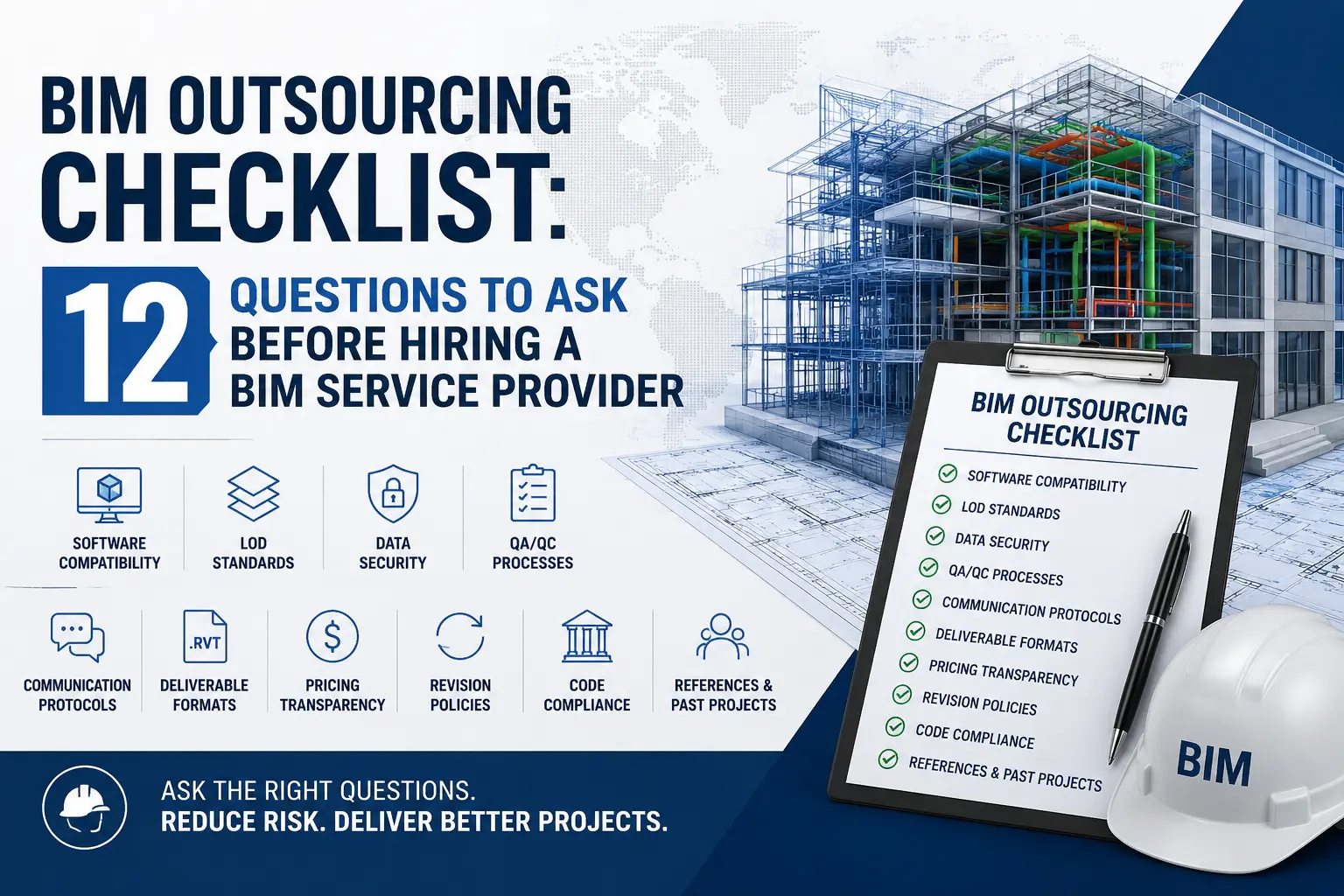
Quick Answer: Before hiring a BIM outsourcing partner, ask these 12 critical questions — covering software compatibility, LOD standards, data security, QA/QC processes, communication protocols, deliverable formats, pricing transparency, revision policies, code compliance, and references. Getting satisfactory answers to all 12 reduces project risk, prevents costly rework, and ensures your BIM service provider is a true extension of your team.
Introduction: Why the Wrong BIM Partner Can Cost You More Than You Save
Building Information Modelling (BIM) outsourcing has become a strategic lever for architecture, engineering, and construction (AEC) firms worldwide. The global BIM market is projected to exceed USD 15 billion by 2029, driven by mandatory BIM adoption in government infrastructure projects across the UK, US, EU, and the GCC region. For firms operating under tight margins, offshoring BIM services — whether for 3D modelling, MEP coordination, clash detection, or construction documentation — can deliver significant cost savings.
But outsourcing BIM work is not as simple as handing over drawings to the lowest bidder. Poor vendor selection leads to model inaccuracies, software incompatibilities, data breaches, missed deadlines, and expensive rework that erases every dollar of savings. The challenge is that most BIM service providers look impressive on their websites — polished portfolios, ISO certifications, and testimonials — but the real differences only surface after you have signed the contract.
This guide arms you with the 12 essential questions every AEC professional must ask before hiring a BIM outsourcing company. Whether you are a principal architect, a BIM manager, a project manager, or a construction firm owner, this BIM outsourcing checklist will help you qualify vendors objectively, spot red flags early, and build a partnership that delivers value for the long term.
What Is BIM Outsourcing? (And Why It Is Growing)
BIM outsourcing refers to the practice of contracting external firms or offshore teams to perform BIM-related tasks that would otherwise be handled in-house. These services span the full project lifecycle:
- BIM modelling and 3D visualisation (Revit, ArchiCAD, Bentley)
- MEP (Mechanical, Electrical, Plumbing) coordination and clash detection
- Structural BIM and reinforcement detailing
- 4D BIM scheduling and 5D cost estimation
- Point cloud to BIM / Scan-to-BIM services
- As-built BIM documentation for facility management (FM-BIM)
- BIM content creation and Revit family creation
- BIM coordination and management as a service
The primary drivers behind BIM outsourcing growth include mandatory BIM requirements on public projects, a shortage of qualified BIM professionals in Western markets, rising software and training costs, increasing project complexity, and compressed project timelines that benefit from round-the-clock offshore workflows.
Why BIM Outsourcing Decisions Go Wrong
Research across AEC forums and project post-mortems consistently reveals the same failure patterns. Understanding these before you start your vendor search is the first step to avoiding them:
- Software version mismatch causing file corruption on delivery
- Offshore teams unfamiliar with local building codes or authority submission requirements
- Poorly defined scope leading to disputes over revision rounds
- Inadequate NDA or data handling policies exposing client IP
- Single point of contact leaving projects stranded when staff turnover occurs
- Impressive portfolio but no verifiable references — modelled work was done by a third party
- Lack of clash detection discipline resulting in costly on-site coordination failures
The difference between a vendor and a true BIM partner is accountability. A vendor delivers files. A partner takes ownership of outcomes, communicates proactively, and invests in understanding your project goals.
The BIM Outsourcing Checklist: 12 Questions to Ask
Use the following questions during your initial vendor discovery calls, RFP process, or due-diligence interviews. Each question includes why it matters, what a strong answer looks like, and what red flags to watch for.
Question 1: What BIM Software Platforms and Versions Do You Work With?
Why this question matters: Software compatibility is the most fundamental and most frequently overlooked aspect of BIM outsourcing. If your in-house team works in Revit 2024 and your vendor delivers models in Revit 2019, you may face file conversion issues, lost parameters, or rendering failures. If your vendor uses ArchiCAD and your structural consultant expects IFC from a Revit-native workflow, interoperability breaks down at the coordination stage.
What a strong answer looks like:
- Proficiency in Autodesk Revit (supported versions — ideally last two releases), Navisworks, AutoCAD, Civil 3D, and/or ArchiCAD
- Familiarity with open BIM standards: IFC 2x3, IFC 4, COBie, and gbXML
- Clear statement of current software versions and upgrade policy
- Experience with BIM collaboration platforms: Autodesk BIM 360 / ACC, Procore, Trimble Connect
Red flags:
- Vague answer: "We work with all major BIM tools" without specifics
- Unable to confirm which Revit version they are currently licensed for
- No mention of IFC or open formats — signals siloed, proprietary workflows
Question 2: What LOD (Level of Development) Standards Do You Follow?
Why this question matters: Level of Development (LOD) defines how much detail, accuracy, and reliability is expected from BIM elements at each project phase. Misalignment on LOD expectations is one of the leading causes of model rework in outsourced BIM projects. A provider that delivers LOD 200 geometry when you need LOD 350 for construction detailing has effectively given you an unusable model for that phase.
LOD quick reference:
- LOD 100 — Concept massing: approximate size and shape
- LOD 200 — Schematic design: generic elements with approximate quantities
- LOD 300 — Design development: precise geometry, size, shape, location
- LOD 350 — Construction documentation: element connections and interfaces defined
- LOD 400 — Fabrication-ready: full fabrication, assembly, and installation detail
- LOD 500 — As-built / FM handover: verified in-place condition
What a strong answer looks like:
- Familiarity with the BIMForum LOD Specification and ability to produce LOD-specific deliverables
- Process for agreeing LOD requirements per discipline per phase in the BIM Execution Plan (BEP)
- Experience producing LOD 500 as-built models for FM handover (COBie/IFC)
Red flags:
- Confused about the difference between LOD and LOI (Level of Information)
- No documented LOD agreement in their standard contracts
- Cannot provide examples of LOD 350 or LOD 400 models
Question 3: Can You Share Relevant Project Experience in Our Sector?
Why this question matters: BIM is deeply sector-specific. A firm that excels at residential Revit modelling may produce dangerously inadequate work on a complex MEP coordination project for a data centre or a heritage restoration with point cloud integration. Each sector carries distinct regulatory requirements, coordination complexity levels, and stakeholder expectations.
Sectors to ask about:
- Healthcare (complex MEP, infection control zoning, equipment BIM)
- High-rise residential and mixed-use (facade coordination, services integration)
- Industrial and manufacturing facilities (heavy MEP, process piping)
- Infrastructure (roads, bridges, tunnels — Civil 3D / OpenBIM workflows)
- Heritage / conservation (scan-to-BIM, irregular geometries)
- Data centres (precision MEP, white space planning)
- Retail and commercial fit-out (tenant coordination, short timelines)
What a strong answer looks like:
- A project portfolio with named projects or detailed anonymised case studies in your sector
- Ability to reference specific coordination challenges and how they were resolved
- Evidence of working within the regulatory framework relevant to your region
Red flags:
- Portfolio heavy on one sector but no experience in the type you need
- Images that look generic — ask for native model files or Navisworks NWD to verify authenticity
- Claims of cross-sector expertise with no supporting detail
Question 4: Who Will Actually Be Working on Our Project?
Why this question matters: The bait-and-switch problem is endemic in BIM outsourcing. A senior BIM manager handles your onboarding call, the proposal is polished, and then your project is handed to a junior drafter with limited experience. Understanding team structure upfront is non-negotiable.
What a strong answer looks like:
- Clear team structure: BIM Lead, modellers, QA reviewer, Project Manager
- Named individuals with LinkedIn profiles or CVs available on request
- Dedicated point of contact — not a shared support inbox
- Policy on staff rotation and what happens if a key team member leaves mid-project
- Minimum qualifications for modellers (Autodesk Certified Professional, years of experience)
Red flags:
- Reluctance to share team details before contract signing
- "We will assign the best resource available" — vague and non-committal
- No named Project Manager — signals unclear accountability
Question 5: How Do You Handle Data Security and IP Protection?
Why this question matters: BIM models contain commercially sensitive design information — structural systems, proprietary facade details, client specifications, and sometimes classified infrastructure data. When you outsource BIM work, you are transmitting this data internationally to a third party. A data breach or IP misuse at the vendor level can expose your firm to serious liability with your own clients.
What a strong answer looks like:
- ISO 27001 certification or equivalent documented information security policy
- Mutual NDA signed before any project information is shared
- Secure file transfer protocols — no unsecured email attachments for model files
- Role-based access controls — modellers only access files relevant to their scope
- Data residency clarity — where are your files stored and which jurisdiction governs?
- Clear IP ownership clause: all work product assigned to client on payment
- No use of your project data to train AI tools or populate portfolio without written permission
Red flags:
- No NDA policy until after contract signing
- Files shared via personal Google Drive or WeTransfer links
- Vague answer: "We take data security very seriously" — no specifics
- No clear IP ownership clause in their standard contract
Question 6: What Is Your Quality Control and Coordination Process?
Why this question matters: Quality assurance in BIM outsourcing is the difference between a model that accelerates your project and one that creates conflict on site. A provider without a structured QA/QC process will deliver models that are geometrically incorrect, miss coordination clashes, or fail model audit checks — all of which cost time and money to resolve.
Key QA/QC elements to probe:
- Clash detection workflow: frequency, software used (Navisworks, Solibri, BIM Collaborate Pro), disciplines coordinated
- Model audit checklist: file naming, workset structure, view templates, purge and compact policy
- Review cycles: how many internal review passes before delivery?
- Use of BCF (BIM Collaboration Format) for issue tracking
- Coordination meeting cadence: weekly clash reviews, bi-weekly model coordination?
- Standards compliance: do models meet BS 1192, ISO 19650-2, or your company BIM standards?
What a strong answer looks like:
- A documented QA/QC checklist shared on request
- Named QA reviewer who is separate from the modelling team
- Regular clash detection reports delivered as part of project milestones
- Zero-clash policy or defined clash acceptance thresholds agreed in the BEP
Red flags:
- QA described as "the modeller checks their own work" — no independent review
- No BCF workflow — issues tracked only via email
- Unable to define what model audit standards they follow
Question 7: How Do You Manage Communication and Time Zone Differences?
Why this question matters: Offshore BIM outsourcing can introduce significant communication friction. A 10-hour time zone gap means a single misunderstood instruction can cost a full working day. Poor communication hygiene compounds exponentially on complex MEP coordination projects.
What a strong answer looks like:
- Defined overlap hours — at least 2 to 3 hours of shared working time per day
- Named communication platforms: Microsoft Teams, Zoom, Slack, or BIM 360 RFIs
- Documented SLAs for response times (e.g., queries responded to within 4 hours during overlap)
- Weekly progress calls with screen-share model reviews
- Written confirmation of verbal instructions — no undocumented scope changes
- Native English-language Project Manager as primary contact
Red flags:
- No defined overlap hours — "we work around your schedule" without specifics
- Communication only via email with 24 to 48 hour response windows
- No video call capability for model reviews
Question 8: What Are Your Deliverable Formats and Handover Standards?
Why this question matters: The value of a BIM model depends entirely on its downstream usability. A model delivered only in proprietary RVT format is inaccessible to stakeholders without Revit licences. A Facility Management handover without COBie data is useless to the asset owner. Understanding exactly what formats and standards are included in the deliverable scope prevents costly surprises at handover.
Common deliverable formats:
- RVT (Revit native) — Design and construction team use
- IFC 2x3 / IFC 4 — Open BIM, multi-discipline exchange, regulatory submission
- NWD / NWC (Navisworks) — Clash detection, 4D simulation, client review
- COBie (xlsx/IFC) — FM handover — asset data for BMS/CAFM systems
- DWG / DXF — Legacy CAD systems, planning authority submissions
- PDF / DWF — 2D drawing issue for record and construction
- gbXML — Energy analysis for green building certification
What a strong answer looks like:
- Explicit list of deliverable formats documented in the contract scope
- Alignment with your project's EIR (Employer's Information Requirements)
- COBie data population for LOD 500 / FM-handover projects
- IFC export validated against your target IFC viewer before formal delivery
Red flags:
- "We deliver in Revit" — and nothing else
- No awareness of COBie or IFC for FM handover
- IFC exports never verified for schema compliance
Question 9: How Do You Price Your Services — and What Is Not Included?
Why this question matters: Hidden costs are the number one source of dispute in BIM outsourcing relationships. An attractively priced proposal that excludes clash detection, QA reviews, interim milestone submissions, or revision rounds beyond the first two will invariably exceed budget. Understanding the full cost structure upfront allows you to compare vendors on a like-for-like basis.
Pricing models to understand:
- Fixed price per project — Best for well-defined scope, single-discipline models
- Hourly rate — Best for evolving scope, ongoing coordination, revision-heavy projects
- Monthly retainer — Best for continuous BIM management, long-duration projects
- Per-element / per-sheet pricing — Best for content creation, Revit family libraries, drawing production
Key cost clarification questions:
- How many revision rounds are included in the base price?
- Is clash detection included, or priced separately?
- Are interim milestone submissions (60%, 90%, IFC) included?
- What happens if the scope changes — is there a formal change order process?
- Are software licences, cloud platform fees, or coordination tools included?
- Are COBie data population and IFC export validation included?
Red flags:
- No formal change order process — scope creep absorbed informally until invoice shock
- Revision limits buried in the fine print of a long contract
- Unusually low per-hour rate without clarity on who is actually doing the work
Question 10: What Does Your Revision and Feedback Loop Look Like?
Why this question matters: Undefined revision policies are the most common source of relationship breakdown in BIM outsourcing. If your contract says "two rounds of revisions" but does not define what constitutes a revision versus a scope change, every iteration becomes a negotiation. A well-structured feedback loop is the mark of a mature BIM service provider.
What a strong answer looks like:
- Defined number of revision rounds per project milestone, documented in the contract
- Use of BCF files or Bluebeam/PDF markup for structured feedback — no verbal-only changes
- Revision turnaround SLA: e.g., minor revisions within 48 hours, major revisions within 5 business days
- Clear definition of "minor revision" vs "major revision" vs "scope change"
- Version control policy: all model versions archived with date-stamped naming
Red flags:
- "Unlimited revisions" — sounds good but signals no process discipline
- Revision scope entirely undefined in the contract
- No version control policy — risk of working from outdated model files
Question 11: Do You Have Experience with Local Codes, Standards, or Regulations?
Why this question matters: This is the question most buyers forget to ask — and one of the most consequential. BIM models that do not align with local building codes, planning authority requirements, or national BIM standards create significant downstream risk. A model built without awareness of UK Part L energy compliance, US IBC accessibility requirements, or UAE DEWA MEP standards may need to be rebuilt from scratch before regulatory submission.
Key standards by region:
- United Kingdom — BS 1192, PAS 1192, ISO 19650-2, UK BIM Framework, NBS Specification
- USA / Canada — LOD Specification (BIMForum), AIA BIM Protocol, IBC, ASHRAE
- Australia / New Zealand — NATSPEC BIM, AS/NZS standards, state-level planning requirements
- UAE / GCC — DEWA standards, ADDC, Dubai Municipality BIM requirements, Estidama (PEARL)
- Europe — EU BIM Task Group guidelines, EN Eurocodes, national adaptations
- India — NBC 2016 BIM provisions, GRIHA rating, RERA compliance
What a strong answer looks like:
- Named experience with the specific standards relevant to your project location
- Familiarity with your planning authority's BIM submission requirements
- ISO 19650-2 workflow capability for UK and internationally procured projects
Red flags:
- "We follow international standards" without specifying which ones
- No knowledge of your country's BIM mandate or EIR requirements
- No experience with authority submission requirements in your jurisdiction
Question 12: Can You Provide References or a Trial Project?
Why this question matters: References and trial projects are the two most powerful due-diligence tools available to you — and the two most commonly skipped in the rush to meet project deadlines. A provider who delivers strong answers to the first 11 questions but cannot provide contactable references or offer a scoped trial has told you everything you need to know.
What a strong answer looks like:
- Two to three contactable references from projects in your sector — live contacts, not just written testimonials
- Willingness to undertake a paid trial task at a fair rate before full engagement
- Sample model files (NDA-protected) that you can open and review in Navisworks or Revit
- Recent third-party reviews on Google, Clutch, or Trustpilot — not only testimonials on their own website
Red flags:
- References only provided as written testimonials on their own website
- Refusal to do a trial — "our portfolio should speak for itself"
- Sample models that are clearly stock Autodesk content, not genuine project work
- References who cannot recall specific project details or team members
Summary: 10 Red Flags That Should Disqualify a BIM Outsourcing Provider
If a vendor triggers three or more of the following, treat that as a strong signal to continue your search:
- Vague answers about team structure, qualifications, or QA process
- No NDA or IP protection policy before data sharing
- Inability to confirm current software versions or IFC export capability
- Portfolio not verifiable — no references, no native files, no detailed case studies
- No defined LOD agreement in their standard contract
- No experience with local codes or standards relevant to your project
- Revision terms undefined or buried in fine print
- Files shared via insecure channels (personal Google Drive, unsecured email)
- No dedicated point of contact or named Project Manager
- Refusal to engage in a scoped, paid trial project
Vendor Evaluation Scorecard
Score each question 1 (poor), 2 (adequate), or 3 (excellent). Providers scoring below 28 out of 36 warrant careful scrutiny. Providers scoring 32 or above are strong candidates for a trial project.
| Question / Criteria | Score (1–3) | Priority | Notes |
|---|---|---|---|
| Software and version compatibility | |||
| LOD standards and documentation | |||
| Sector-specific experience | |||
| Team structure and dedicated PM | |||
| Data security and NDA | |||
| QA/QC and coordination process | |||
| Communication and time zone overlap | |||
| Deliverable formats (IFC / COBie / RVT) | |||
| Pricing transparency | |||
| Revision and feedback process | |||
| Knowledge of local codes (ISO 19650) | |||
| References and trial project option | |||
| Total | /36 |
Scoring guide: 32–36 = Strong candidate (proceed to trial). 24–31 = Conditional (address gaps before proceeding). Below 24 = Do not proceed.
How to Run the BIM Vendor Selection Process
Step 1 — Define Your Requirements (EIR / BIM Brief)
Before approaching any vendor, document your Employer's Information Requirements (EIR) or equivalent BIM brief. This should specify required software platforms, LOD by phase and discipline, deliverable formats, data security requirements, and communication expectations. Without this, you cannot objectively evaluate vendor responses.
Step 2 — Issue a Short-Form RFP
Send a structured Request for Proposal to three to five shortlisted vendors. Include the 12 questions above as required response items. Standardising the questions allows direct comparison and prevents vendors from deflecting with marketing language.
Step 3 — Conduct Discovery Calls
Schedule 45-minute discovery calls with each vendor. Ask the 12 questions verbally — the quality of the conversation reveals far more than written responses. Listen for hesitation on data security, LOD specifics, and references.
Step 4 — Score and Shortlist
Apply the scorecard above to each vendor. Shortlist the top two or three candidates with scores above 28.
Step 5 — Run a Paid Trial Project
Commission a scoped, paid trial task with each shortlisted vendor. A realistic trial might be: model two floors of a building from issued drawings, produce a Navisworks clash report, and deliver IFC and RVT. Evaluate the output against your LOD requirements, quality standards, and communication experience.
Step 6 — Negotiate the Contract
Once you have selected your preferred vendor, ensure the contract addresses: LOD agreement per phase, revision terms, IP ownership, data security obligations, SLAs for turnaround and communication, escalation procedures, and termination clauses.
Frequently Asked Questions: BIM Outsourcing
What is the average cost of BIM outsourcing?
BIM outsourcing rates vary significantly by geography and scope. Offshore BIM modelling rates typically range from USD 15–40 per hour for South Asian providers, USD 20–50 per hour for Southeast Asian teams, and USD 40–80+ per hour for Eastern European firms. Always compare total cost of ownership — including revision rounds, QA, and coordination meetings — not just the headline hourly rate.
What is the difference between BIM outsourcing and BIM offshoring?
BIM outsourcing refers to contracting external firms to deliver BIM services, regardless of location. BIM offshoring specifically refers to working with providers in lower-cost countries to achieve cost savings. All BIM offshoring is outsourcing, but not all BIM outsourcing is offshoring.
What BIM standards should I require my outsourcing provider to follow?
The standard you require depends on your project location and client. For UK projects: ISO 19650-2 and the UK BIM Framework. For US projects: the BIMForum LOD Specification and the AIA BIM Protocol. For international projects: ISO 19650-1 and ISO 19650-2. For government or infrastructure projects, always check the Employer's Information Requirements (EIR) issued by the client.
How do I protect my intellectual property when outsourcing BIM work?
Protecting IP in BIM outsourcing requires a multi-layered approach: sign a comprehensive NDA before sharing any project data; include an explicit IP assignment clause in the contract; use secure file-sharing platforms with role-based access controls; prohibit the vendor from using your project data for portfolio display or AI training without written consent; and verify that the vendor holds ISO 27001 or equivalent certification.
What is a BIM Execution Plan (BEP) and should I require it from an outsourcing provider?
A BIM Execution Plan (BEP) is a document — often required by the Employer's Information Requirements — that defines how BIM will be implemented on a specific project. It covers software platforms, LOD by phase, file naming conventions, collaboration protocols, and responsibility matrices. You should require your outsourcing provider to either contribute to or produce the project BEP. A provider unwilling to engage with a BEP is unlikely to deliver ISO 19650-compliant outputs.
Is BIM outsourcing suitable for small architecture or engineering firms?
Absolutely. BIM outsourcing can be more beneficial for small and mid-sized AEC firms than for large ones, because it provides access to specialist expertise — MEP coordination, scan-to-BIM, structural detailing — without the overhead of full-time hiring. Start with a small, well-defined pilot project to establish workflow compatibility before committing to a long-term engagement.
Conclusion: The Right BIM Partner Is an Extension of Your Team
Selecting a BIM outsourcing partner is not a procurement decision — it is a strategic one. The 12 questions in this checklist are designed to shift the conversation from price and portfolio to process, standards, and accountability. A provider who answers all 12 with specificity, transparency, and evidence is a provider who has invested in building a professional BIM operation — not just a modelling shop.
The AEC industry is becoming more complex, more regulated, and more data-driven by the year. BIM is no longer a nice-to-have — it is the backbone of project delivery, from design through construction to facility management. The BIM service provider you choose will shape the quality of your models, the efficiency of your coordination process, and ultimately the success of your project.
Use this checklist. Run the scorecard. Do the trial project. And remember: the cost of a poor BIM outsourcing decision is measured not just in wasted fees, but in rework, delays, and damaged client relationships.
If you want to skip the lengthy vendor evaluation process altogether, the team at BuiltInBIM has already answered every question on this checklist — and can prove it.
Ready to Work with a Trusted BIM Outsourcing Partner?
Stop searching. Start building.
BuiltInBIM is a specialist BIM outsourcing firm trusted by architects, engineers, and contractors across the UK, USA, UAE, and Australia. Here is what you get from day one:
- Revit modelling, MEP coordination, and clash detection — from LOD 100 to LOD 500
- ISO 19650-compliant BIM workflows with a documented BEP for every project
- Secure data handling — NDA on day one, ISO 27001-aligned protocols
- Dedicated Project Manager and named BIM Lead on every engagement
- A free scoped trial so you can evaluate our work before committing
Get a free project consultation — no obligation, no pressure.
Already reviewed the checklist? Score your current or prospective BIM provider using the vendor scorecard above and share the results with the BuiltInBIM team for a free expert second opinion.