
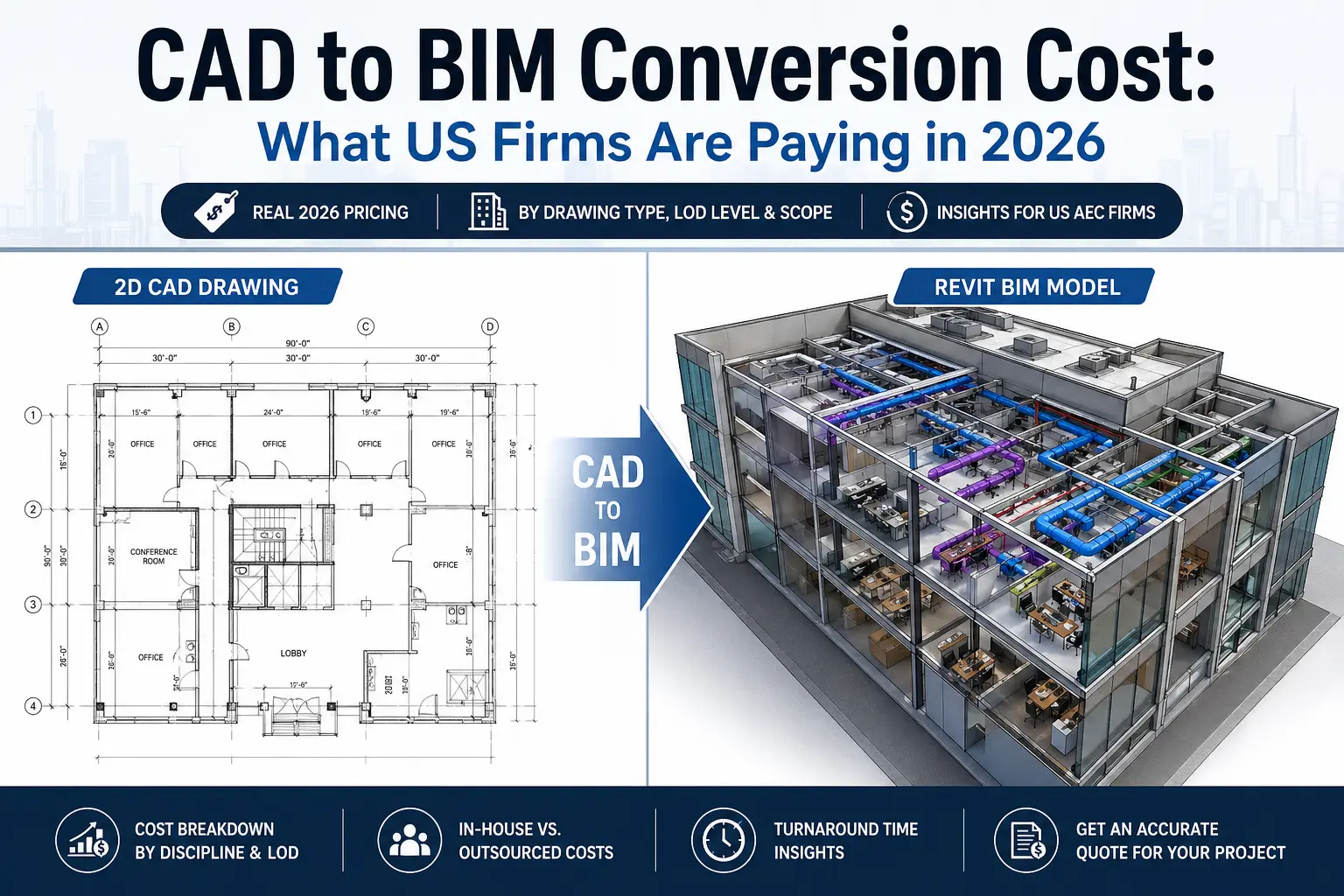
Most US firms that request a CAD to BIM conversion quote get surprised — not because the cost is high, but because they had no benchmark to compare it against. A simple 2D floor plan conversion can run $15–$40 per sheet. A full multi-discipline, LOD 400 commercial project can reach $15,000–$20,000 or more. The range is wide because the variables are wide.
This article gives BIM managers, VDC leads, general contractors, and small-to-mid-size AEC firm owners a clear picture of CAD to BIM conversion cost in the USA for 2026. You’ll find real pricing ranges broken down by drawing type, LOD level, and discipline — plus a comparison of in-house versus outsourced costs, what’s typically included in a conversion package, and how to get a quote that reflects your actual scope.
What Drives CAD to BIM Conversion Cost in the USA?
Before quoting a number, every competent BIM provider needs to understand four variables. These are what move the price up or down more than anything else.
1. Drawing quality and completeness
Clean, well-organised CAD files convert faster than fragmented legacy drawings with missing layers, inconsistent scales, or hand-scanned PDFs. Firms submitting clean DWG files pay measurably less per sheet than those handing over scanned blueprints or mixed-format archives.
2. LOD (Level of Detail) required
LOD 200 — massing and approximate geometry — is significantly less work than LOD 400, which requires fabrication-ready element geometry, connection details, and embedded data. The LOD target is the single biggest cost multiplier in any conversion project.
3. Number of disciplines
Architectural-only conversion is priced differently from a full MEP + architectural + structural package. Each discipline adds modelling hours and coordination complexity.
4. Building complexity and size
A 3,000 sq ft residential building and a 300,000 sq ft commercial tower are not in the same pricing category, even at the same LOD level. Floor count, system complexity, and repetition all affect hours required.
CAD to BIM Conversion Cost USA: 2026 Pricing Breakdown
The figures below reflect current market rates for outsourced BIM conversion services in the USA. Rates vary based on provider tier, scope definition, and whether the firm is working with a dedicated BIM partner or a transactional vendor.
By drawing type
| Drawing Type | Price Range (USD) | Notes |
|---|---|---|
| Single 2D floor plan → Revit (LOD 200) | $15 – $40 per sheet | Clean CAD input, architectural only |
| Single 2D floor plan → Revit (LOD 300) | $35 – $80 per sheet | Includes wall types, door/window schedules |
| Mechanical/HVAC drawing → 3D BIM | $50 – $120 per sheet | Duct routing, equipment placement |
| Electrical drawing → 3D BIM | $40 – $100 per sheet | Panels, conduit, lighting fixtures |
| Plumbing drawing → 3D BIM | $40 – $100 per sheet | Pipe routing, fixtures, equipment |
| Structural drawing → 3D BIM | $60 – $150 per sheet | Steel, concrete, connections |
| Full PDF/scan to BIM (per sheet) | $50 – $180 per sheet | Add 25–40% over equivalent clean CAD rates |
By LOD level (full building, per discipline)
| LOD Level | Typical Cost Range | What It Covers |
|---|---|---|
| LOD 100 | $500 – $1,500 | Conceptual massing, site context |
| LOD 200 | $1,200 – $4,000 | Approximate geometry, major systems |
| LOD 300 | $3,000 – $10,000 | Accurate geometry, specifications, schedules |
| LOD 400 | $7,000 – $20,000 | Fabrication-ready, full data embedding |
| LOD 500 | $12,000 – $30,000 | As-built verified, facility management ready |
Ranges assume a mid-size commercial building (50,000–150,000 sq ft), single discipline. Multi-discipline projects are scoped separately.
By project type
| Project Type | Typical Total Cost (Outsourced) |
|---|---|
| Single-family residential, architectural only | $300 – $1,200 |
| Multi-family (20–50 units), architectural + MEP | $2,500 – $8,000 |
| Mid-rise commercial (5–15 floors), full MEP + arch | $8,000 – $22,000 |
| Large commercial / healthcare (15+ floors) | $18,000 – $60,000 |
| Industrial / warehouse, structural + MEP | $5,000 – $15,000 |
In-House vs. Outsourced: What the True Cost Comparison Looks Like
Many firms underestimate in-house CAD to BIM conversion costs because they only count software licenses and salary hours. The real picture includes ramp-up time, QA, and opportunity cost.
| Cost Factor | In-House | Outsourced (Built In BIM) |
|---|---|---|
| Staff hourly rate (loaded) | $65 – $110/hr | $12 – $25/hr (offshore expert rate) |
| Revit license cost | $3,100+/yr per seat | Included |
| Training / ramp-up time | 40–120 hrs for CAD-to-BIM workflow | None — dedicated team |
| QA and coordination overhead | 15–25% additional hours | Included in scope |
| Turnaround flexibility | Limited by headcount | Scalable on demand |
| Risk if modeller leaves | High — knowledge loss | None — team continuity |
| Typical 10,000 sq ft conversion | $3,500 – $7,000 total | $800 – $2,200 total |
The outsourced cost advantage compounds on larger projects. A mid-rise commercial conversion that would require 3–4 in-house staff for 6 weeks can be delivered by a dedicated offshore BIM team in 2–3 weeks at a fraction of the all-in cost.
What’s Included in a Professional CAD to BIM Conversion Package
Understanding CAD to BIM conversion price per drawing only tells part of the story. A well-scoped package from a quality provider should include:
Deliverables
- Native Revit (.RVT) model files, organised by discipline and floor
- Navisworks-compatible (.NWC / .NWD) files for coordination and clash detection
- IFC export for interoperability with non-Revit workflows
- 2D documentation extracted from the model (floor plans, sections, elevations, schedules)
- Clash report if MEP coordination is in scope
Standards compliance
- LOI (Level of Information) and LOD matrix aligned to the project BEP (BIM Execution Plan)
- Compliance with AIA E203, NBIMS-US, or project-specific BIM standards
- Autodesk Revit best practices per Autodesk’s BIM guidelines
Quality assurance
- Internal model audit before delivery (no floating elements, proper category assignment, clean parameter data)
- Revision cycle included (typically one round of comments)
Communication
- Dedicated BIM project manager as single point of contact
- Milestone-based delivery with progress updates
CAD to BIM Conversion Turnaround Times
Turnaround depends on scope, not just drawing count. Here are realistic timelines for outsourced conversion projects:
| Scope | Typical Turnaround |
|---|---|
| 5–10 sheets, single discipline, LOD 200–300 | 3–7 business days |
| 20–50 sheets, architectural + MEP, LOD 300 | 2–4 weeks |
| Full building, multi-discipline, LOD 300–400 | 4–10 weeks |
| Large complex (hospital, airport, campus), LOD 400 | 10–20 weeks |
Rush delivery (compressed timelines) is possible with additional resource allocation — typically priced at a 20–35% premium. Built In BIM’s team operates across time zones, which enables overnight progress cycles on urgent projects.
How to Get a CAD to BIM Conversion Quote That’s Actually Accurate
Vague quote requests produce vague pricing. To get a reliable figure, provide:
- The full drawing set (or a representative sample) — even PDFs are enough for scoping
- The LOD target — if you’re unsure, specify the intended use (design coordination vs. fabrication vs. as-built record)
- Disciplines required — arch only, MEP, structural, or full building
- BIM Execution Plan or project brief — if one exists
- Delivery format and standards — Revit version, IFC requirement, naming conventions
With those five inputs, a competent provider can turn around a fixed-fee quote within 24–48 hours — no hourly-rate estimates, no open-ended scopes.
If you’re ready to scope your conversion project, get a free BIM quote from Built In BIM. The team reviews your drawings and provides a fixed-price proposal with a clear scope of work, timeline, and deliverables.
Frequently Asked Questions
What is the average CAD to BIM conversion cost in the USA?
For a typical mid-size commercial project (50,000–150,000 sq ft) at LOD 300, most US firms are paying between $8,000 and $22,000 for a full architectural and MEP conversion when outsourcing to a specialist offshore BIM provider. Smaller residential or single-discipline projects can be completed for $800–$3,000. The CAD to BIM conversion cost in the USA varies significantly based on drawing quality, LOD target, number of disciplines, and project complexity — which is why a fixed-fee quote based on your actual scope is always more reliable than a per-sheet estimate.
How is CAD to BIM conversion price per drawing calculated?
Most providers calculate a base rate per drawing sheet, then apply multipliers for LOD level, discipline complexity, and drawing quality. A clean architectural floor plan at LOD 300 might be $35–$80 per sheet, while a complex MEP drawing requiring routing and equipment placement at LOD 400 could be $100–$200 per sheet. Providers who quote a flat “price per drawing” without reviewing your files should be treated with caution — scope matters more than sheet count.
Can I convert scanned PDFs or hand-drawn blueprints to BIM?
Yes, but expect to pay 30–50% more than equivalent clean CAD conversions. PDF-to-BIM and scan-to-BIM workflows require additional redrawing and interpretation steps. The quality of the source scan affects accuracy — 300 DPI or higher is recommended for reliable extraction.
What Revit version will my converted files be in?
A reputable provider will deliver files in the version you specify, typically the current release or one version back (Revit 2024 or 2025 as of 2026). Always confirm the target version before project kick-off — downgrading Revit files after delivery is not straightforward.
How long does CAD to BIM conversion take for a 10-floor commercial building?
A 10-floor commercial building with architectural and full MEP disciplines at LOD 300 typically takes 4–7 weeks with a dedicated offshore BIM team. Structural addition or LOD 400 requirement extends this to 7–12 weeks. Built In BIM’s team can accelerate timelines through parallel workflow — different disciplines modelled simultaneously by separate worksets.
Do I need a BIM Execution Plan before starting conversion?
It’s strongly recommended but not always required for smaller scopes. For any project above LOD 300 or involving multiple disciplines, a project-specific BEP aligned to NBIMS-US standards ensures the model is built to a consistent standard and is usable by all downstream parties. Built In BIM can assist in drafting or reviewing a BEP as part of project kick-off.