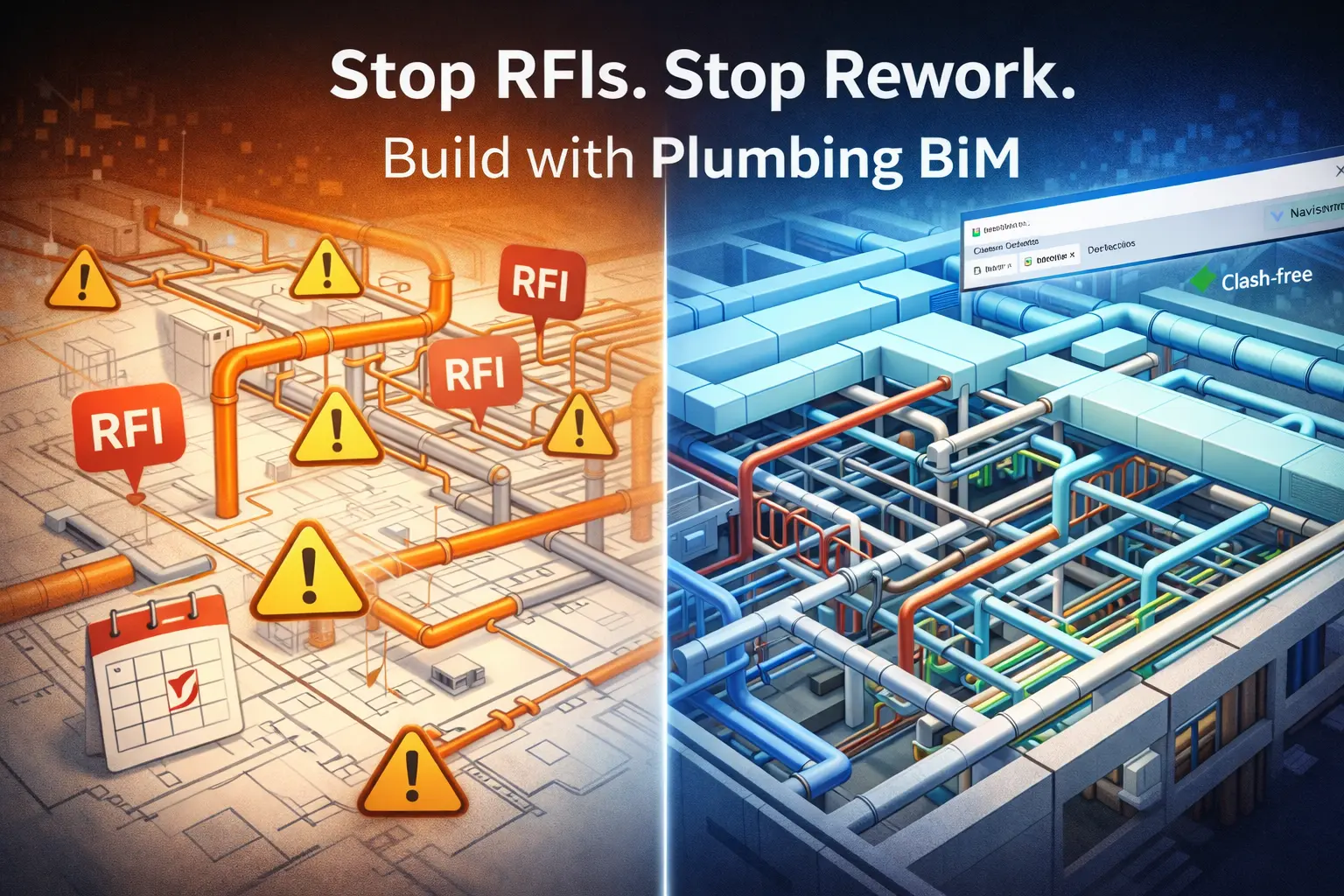
If you've managed a plumbing subcontract on a US commercial project in the last five years, you already know the pattern: the RFI log grows faster than the walls go up, clashes discovered in the field send crews back to the shop, and your carefully planned schedule slips week after week.
According to the FMI Construction Productivity Report, rework and coordination failures cost the US construction industry an estimated $177 billion annually — and MEP trades, including plumbing, shoulder a disproportionate share of that cost.
The good news: plumbing contractors who have adopted Revit-based BIM modeling are breaking this cycle. They are closing projects with significantly fewer RFIs, avoiding costly field rework, and winning more bids because they can demonstrate a track record of on-time, clash-free delivery.
This guide explains exactly how plumbing BIM modeling eliminates the three biggest profit killers on US commercial and healthcare projects: RFI floods, clash-caused rework, and schedule delays.
The RFI Crisis Hitting US Plumbing Contractors
An RFI — Request for Information — is supposed to be a formal clarification tool. In practice, on most US commercial projects, it becomes a symptom of something more fundamental: the 2D design drawings didn't fully account for what happens when plumbing pipe, HVAC ductwork, electrical conduit, structural steel, and fire suppression systems all have to share the same limited ceiling plenum.
The numbers tell a sobering story:
- 48% of all RFIs on US commercial projects are MEP-related (Dodge Data & Analytics)
- 15–20% of total project cost is lost to rework on average US construction projects (NIST)
- $4.2 billion is the estimated annual cost of MEP rework in US commercial construction
For plumbing subs specifically, the RFI problem compounds quickly. A single unresolved conflict between a waste stack and a structural beam can generate a chain of 6–10 follow-on RFIs as engineers, GCs, and subcontractors negotiate the resolution across days or weeks. Meanwhile, your crew stands by, burns overhead, and falls behind on rough-in.
The Three Core Drivers of Plumbing RFIs on US Projects
- Inadequate coordination in 2D: Traditional plumbing drawings show pipes in plan view but rarely account for three-dimensional conflicts with other trades. A 2D drawing might show a 4-inch drain pipe at elevation -10", but it won't tell you that a structural beam is running at -9.5" in the same bay.
- Late design changes: Architectural and structural changes late in the design phase ripple through plumbing layouts. With 2D drawings, every revision requires manual redrawing and re-coordination — generating RFIs even before the first pipe is hung.
- Incomplete reflected ceiling plans: On commercial projects with complex ceiling grids, plumbing rough-in locations often conflict with HVAC diffusers, light fixtures, and sprinkler heads. These clashes are nearly impossible to catch in 2D and consistently produce costly field RFIs.
Real-World Scenario — 2D Plumbing Coordination Gone Wrong
A 220,000 sq. ft. mixed-use commercial development in Austin, TX used traditional 2D CAD coordination. The plumbing subcontractor submitted shop drawings based on the architect's reflected ceiling plan, which didn't account for HVAC duct routing in the Level 3 mechanical room.
Result: 34 RFIs generated in the first 6 weeks of rough-in. Average resolution time: 8.5 days per RFI. Total schedule impact: 11 weeks of plumbing delay. Estimated rework cost: $310,000 in labor and materials.
The GC ultimately required the plumbing sub to produce basic 3D clash-detection models before any further work proceeded — a cost that could have been avoided entirely with upfront BIM modeling.
How Revit Plumbing BIM Modeling Prevents RFIs
Building Information Modeling — specifically Revit MEP — fundamentally changes the coordination equation for plumbing contractors. Instead of discovering conflicts in the field when your crew is already on-site with materials staged, BIM surfaces those conflicts during the design phase, when they cost a fraction of what field rework does.
Here's how Revit-based plumbing 3D modeling services attack each of the three core RFI drivers:
1. Full 3D Clash Detection — Eliminating Conflicts Before Mobilization
In a coordinated BIM model, your plumbing system — sanitary, domestic water supply, hot water return, medical gas (in healthcare), storm drainage — exists in full three-dimensional space alongside the HVAC ductwork, electrical conduit, structural framing, and architectural elements.
Navisworks clash detection runs against this federated model and flags every intersection. It catches three types of conflicts that 2D drawings routinely miss:
- Hard clashes: Two elements physically occupying the same space (e.g., a 6-inch drain pipe intersecting with a wide flange beam). These would stop construction cold.
- Soft clashes (clearance conflicts): Elements that don't intersect but violate minimum clearance requirements — for example, a supply line within 1 inch of a structural column when maintenance access requires 12 inches minimum.
- Workflow clashes: Installation sequence conflicts where one trade's work blocks another's access. Common in mechanical rooms and shaft conditions.
Data Point — Clash Detection ROI
A 2022 study by the Construction Industry Institute found that for every $1 invested in pre-construction BIM coordination, projects saved an average of $8.60 in field RFI and rework costs.
For a typical $2.5M plumbing scope on a 150,000 sq. ft. commercial building, that means a $25,000 investment in plumbing BIM modeling could prevent up to $215,000 in downstream rework costs.
2. Coordinated Shop Drawings Generated Directly from the BIM Model
One of the most powerful advantages of Revit plumbing BIM is that coordinated shop drawings are generated directly from the clash-resolved 3D model. This means:
- No interpretation errors: Dimensions, elevations, and routing shown in shop drawings exactly match the 3D model — eliminating the manual redrawing errors that plague CAD-to-shop-drawing workflows.
- Automatic updates: When a pipe route is adjusted in the model to resolve a clash, all affected plan views, sections, and elevations update automatically. No manual redrawing, no version control nightmares.
- Spool sheet generation: For prefabrication-oriented plumbing subs, Revit can generate pipe spool sheets directly from the model, enabling shop fabrication of pipe assemblies before mobilization.
When shop drawings match reality — because they were generated from a coordinated 3D model — field questions about "what was intended" essentially disappear.
3. Single Source of Truth — Eliminating Drawing Version Conflicts
On a traditional 2D project, the GC, plumbing sub, HVAC sub, and electrical sub each maintain their own set of drawings — which quickly diverge as revisions are issued. Your crew may be working from a different version than the GC's super, generating RFIs that are really just "which version is current?" questions.
In a BIM workflow, all trades work from and against a single federated model hosted in BIM 360 (Autodesk Construction Cloud). When the structural engineer issues a beam revision, it propagates to the coordinated model immediately — and every trade can see the impact on their systems in real time. Version conflicts — and the RFIs they generate — are eliminated by design.
Before & After: Plumbing BIM in Action on US Projects
The following scenarios are composite illustrations based on typical outcomes from US commercial and healthcare projects that adopted Revit-based MEP BIM coordination.
Scenario A: 180,000 Sq. Ft. Commercial Office Building — Dallas, TX
| ❌ Without Plumbing BIM | ✓ With Revit Plumbing BIM |
|---|---|
| Traditional 2D CAD shop drawings prepared from architectural reflected ceiling plans | Full Revit MEP model created from architectural, structural, and MEP design drawings |
| 47 plumbing-related RFIs generated during rough-in phase (weeks 6–22) | 6 RFIs generated during entire rough-in phase — an 87% reduction |
| 14 field rework events, avg. cost $8,400/event = $117,600 in rework labor | 2 minor field adjustments, total cost $4,200 — 96% rework cost reduction |
| Plumbing rough-in ran 9 weeks over schedule due to coordination delays | Plumbing rough-in completed 4 days ahead of schedule |
| GC withheld $85,000 in retainage due to delay-related backcharges | Full retainage released. Sub received early completion bonus of $22,000 |
Scenario B: 95-Bed Community Hospital Expansion — Charlotte, NC
Healthcare plumbing is in a category of its own for complexity. Medical gas systems, sterile water loops, complex drainage grades for infection control, and strict clearance requirements around equipment all create a coordination environment where 2D-only workflows are genuinely inadequate.
| ❌ Without Plumbing BIM | ✓ With Revit Plumbing BIM |
|---|---|
| Plumbing and medical gas shop drawings prepared separately from mechanical coordination | Fully integrated Revit MEP model including plumbing, medical gas, HVAC, and electrical |
| 61 plumbing-related RFIs — 23 related to medical gas, 38 to drainage and domestic water conflicts | 8 RFIs total — all minor clarifications, none requiring field rework |
| Surgical suite rough-in delayed 7 weeks due to uncoordinated ceiling plenum | Surgical suite rough-in completed on schedule — zero ceiling conflicts at inspection |
| Joint Commission inspection required 3 additional visits due to coordination non-conformances | Joint Commission clearance obtained in single inspection — no plumbing deficiencies noted |
| Total cost of coordination failures: $485,000 | BIM coordination cost: $38,500 | Net savings: $446,500 |
The Schedule Domino Effect — and How BIM Breaks It
RFIs don't just cost money in isolation. On a commercial project with a GC-managed CPM schedule, every unresolved plumbing RFI has downstream consequences. Here's the cascade:
Plumbing rough-in stalled → Electrical rough-in blocked → Drywall can't start → Finishes delayed → Commissioning pushed → Certificate of Occupancy delayed → Owner liquidated damages triggered
In a 2023 survey by the Associated General Contractors of America, GCs reported that plumbing and HVAC coordination failures were the single most common cause of subcontractor-driven schedule delays on US commercial projects over 100,000 sq. ft.
How Revit Plumbing BIM Compresses Your Schedule in 4 Ways
- Pre-construction clash resolution: All conflicts are identified and resolved in the virtual model before your crew mobilizes. Zero discovery time lost to field problem-solving.
- Prefabrication readiness: Spool sheets generated from the Revit model allow pipe assemblies to be fabricated in the shop concurrent with site preparation. Prefab adoption typically reduces plumbing installation labor by 15–25%.
- Faster submittal approval: BIM-derived shop drawings are easier for engineers and GCs to review. Typical review cycle drops from 3–4 weeks (2D) to 1–2 weeks (BIM-derived).
- Reduced change order negotiation time: When a change order IS required, the BIM model provides a definitive reference for what was designed vs. what changed — eliminating weeks-long disputes over scope.
What You Get: Deliverables from a Plumbing BIM Engagement
When you engage a professional Revit plumbing modeling service, the deliverable is not simply a 3D model to look at on a screen. The full package of construction-ready outputs includes:
| Deliverable | What It Gives You on Site |
|---|---|
| Coordinated Revit MEP Model (LOD 300–400) | Full 3D plumbing model — domestic water supply, hot water return, sanitary drainage, vent stacks, storm drainage, and medical gas — coordinated against all other MEP trades and structure |
| Navisworks Clash Detection Report | Full list of all identified clashes with type, severity, responsible trade, and recommended resolution — delivered before your crew mobilizes |
| Coordinated Shop Drawings | Plan views, sections, elevations, and details generated directly from the coordinated Revit model — submittal-ready and engineer-reviewable |
| Pipe Spool Sheets | Cut-list-ready spool drawings for shop fabrication of pipe assemblies, complete with material callouts and connection specifications |
| Isometric Drawings | 3D isometric views of complex pipe assemblies — especially valuable for mechanical rooms and shaft conditions |
| Material Quantity Takeoffs | BIM-derived pipe quantities, fixture counts, and fitting schedules ready for procurement and buyout |
| Construction-Phase RFI Support | Ongoing model maintenance and RFI response support throughout the construction phase — so field issues are resolved against a live model, not guesswork |
LOD Levels Explained for Plumbing Contractors
LOD 300 — Modeled plumbing systems show accurate size, shape, location, and connectivity. Suitable for coordination and clash detection. Typical for commercial office and retail projects.
LOD 350 — Adds connection points, supports, hangers, and interface information. Suitable for shop drawing production and multi-trade coordination.
LOD 400 — Fabrication-level detail. Complete pipe spool sheets, cut lengths, and connection hardware specifications. Required for prefabrication projects. Healthcare projects typically require LOD 350–400.
Which US Projects Benefit Most from Plumbing BIM Modeling?
Not every plumbing scope justifies a full BIM modeling engagement. But for these project types, the ROI is consistently positive:
- Healthcare facilities (hospitals, surgery centers, medical office buildings): Complex plumbing systems, strict code requirements (NFPA 99, FGI Guidelines), and zero tolerance for rework make BIM essential for any healthcare project over 40,000 sq. ft.
- High-rise commercial and multi-family: Stack effect and vertical coordination in high-rise plumbing creates challenges that 2D drawings cannot capture. BIM reduces riser conflicts — a common RFI driver — by 80%+ in coordinated projects.
- Industrial and manufacturing facilities: Process piping, sanitary systems, and utility connections benefit enormously from 3D coordination given system density and complexity.
- Data centers: Mission-critical cooling water systems, complex mechanical room configurations, and zero-downtime requirements make data center plumbing BIM essential.
- Large-scale commercial (100,000 sq. ft. and up): At this scale, even a 5% reduction in RFI volume translates to 6-figure savings.
Quick Diagnostic: Does Your Project Need Plumbing BIM?
| Warning Sign on Your Project | BIM Needed? |
|---|---|
| Your last 2–3 projects had 20+ plumbing RFIs during rough-in | Yes |
| You've had backcharges or retainage disputes related to plumbing coordination delays | Yes |
| The GC is requiring a BIM Execution Plan (BEP) or Level of Development (LOD) specification | Yes |
| The project involves healthcare, industrial, or data center end use | Yes |
| The ceiling plenum is congested (structural + HVAC + plumbing + electrical + fire protection in same zone) | Yes |
| The design team produced LOD 200 or lower design-intent models without full MEP coordination | Yes |
| Your crew is mobilized from out of market — field rework is especially costly | Yes |
If 3 or more of these apply, plumbing BIM modeling will almost certainly pay for itself on your next project.
Frequently Asked Questions: Plumbing BIM Modeling for US Projects
How long does it take to produce a coordinated plumbing BIM model?
For a typical commercial project of 80,000–150,000 sq. ft., initial plumbing BIM modeling takes 2–4 weeks depending on design document completeness, LOD requirements, and system complexity. Clash detection and coordination with other trades typically adds 1–2 additional weeks.
What do you need from us to start?
At minimum: (1) MEP design intent drawings or existing design-level BIM models in Revit or IFC format; (2) architectural drawings (PDF or DWG) for spatial reference; (3) structural drawings; and (4) the project's BIM Execution Plan if the GC has issued one.
Do you coordinate with other MEP trades or just plumbing?
BuiltInBIM offers full MEP BIM coordination services — mechanical/HVAC, electrical, plumbing, fire protection, and architectural/structural coordination — as a combined engagement or as individual trade packages.
What Revit version do you work in?
We work in Revit 2022, 2023, and 2024. We can also accept and deliver IFC 2x3/2x4 and import CAD (DWG/DGN) reference files.
How does pricing work for plumbing BIM services?
We price based on project scope (square footage, system complexity, LOD requirement, and number of coordination rounds). For a typical commercial project of 100,000–150,000 sq. ft. at LOD 350, expect an investment in the range of $18,000–$35,000. Contact us for a project-specific quote — we typically respond within 24 hours.
RFIs Are a Choice — Choose BIM
The plumbing RFI problem isn't random. It's the predictable result of trying to coordinate three-dimensional trade work using two-dimensional drawings. US plumbing contractors who have adopted Revit plumbing modeling have consistently demonstrated that 70–90% of coordination-related RFIs are preventable — not at the job site, but in the model.
For a commercial or healthcare plumbing subcontractor doing $5M–$25M per year in work, even a conservative 50% reduction in RFI-related delays and rework translates to $200,000–$600,000 in recovered margin annually. That's the difference between a 4% net margin and an 8% net margin on the same revenue.
The question isn't whether plumbing BIM modeling delivers ROI. The question is which project you start with.
Ready to Start Your Plumbing BIM Project? Risk-free pilot available — if you're not satisfied with the deliverables, you don't pay. Get a Free Quote →