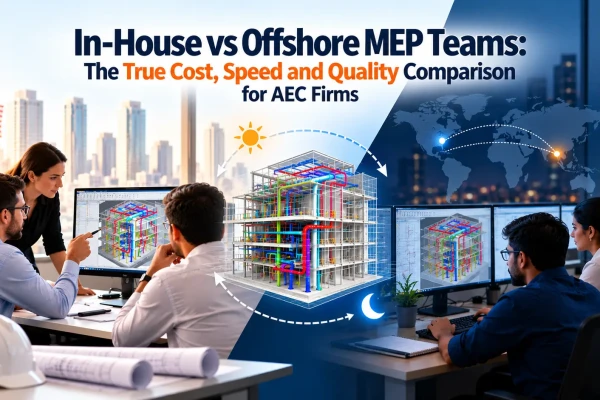
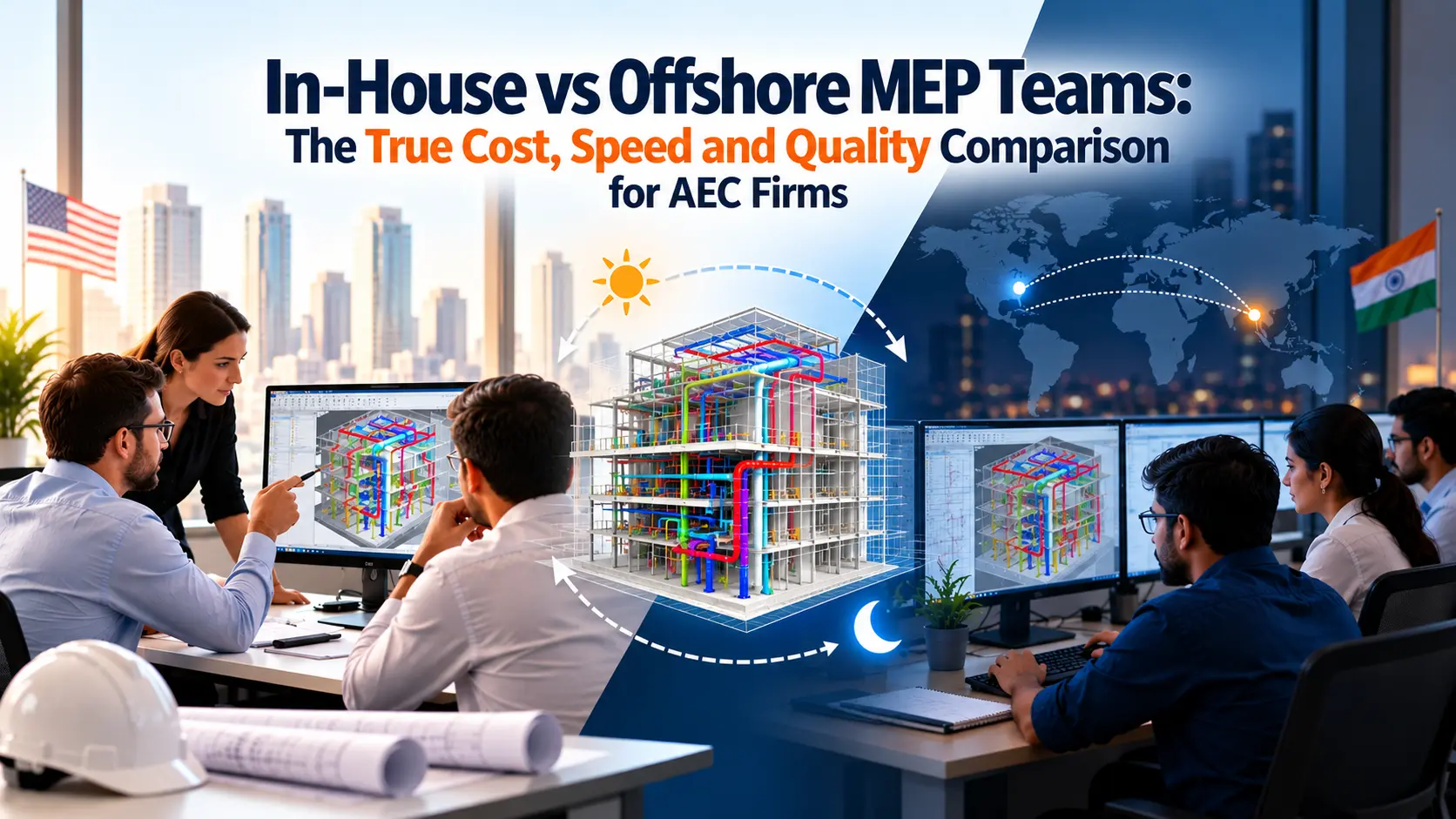
Hiring MEP talent in the US is still hard in 2026. In the latest AGC–NCCER Workforce Survey, 87–90% of construction firms said open salaried or hourly craft positions were difficult to fill, and labor shortages remain the top cause of project delays. That pressure is why so many AEC firms are comparing in-house vs offshore MEP teams. This guide prices both models the same way, shows where each one is faster, explains how quality and US licensure rules really work, and ends with a task-by-task plan for a hybrid team.
Quick answer: An in-house MEP team gives the most control and the fastest back-and-forth during design, but it carries fixed payroll, benefits and software costs. An offshore MEP team lowers the cost of production work such as modeling, drafting and clash reports, and can work overnight. Most firms get the best result from a hybrid model.
Key takeaways
- Price both options as fully loaded cost per productive hour, not salary vs hourly rate.
- In June 2026, benefits made up 30.0% of what US private employers spent on compensation (BLS).
- Offshore teams speed up production but can slow down live coordination unless you set a daily overlap window.
- Quality depends on the BIM Execution Plan, templates and QA/QC, not on where the team sits.
- Offshore teams can prepare MEP documents, but a licensed US engineer in responsible charge must direct the work and seal it.
What is the difference between in-house and offshore MEP teams?
An in-house MEP team is made up of engineers, designers and BIM modelers employed directly by your firm. An offshore MEP team is a dedicated group of MEP engineers and BIM specialists in another country, often India, who work on your projects through a service partner.
The key difference is who carries the fixed cost and where the work happens. In-house staff sit inside your culture and time zone. An offshore team works as an extension of your office, usually on production tasks, while your own engineers keep design authority.
Offshore is not the same as outsourcing. Outsourcing means a third party does the work. Offshoring means the work is done in another country. A dedicated offshore team is both, but you direct it day to day, much like your own staff.
In-house vs offshore MEP teams at a glance
| Factor | In-house MEP team | Offshore MEP team |
|---|---|---|
| Cost structure | Fixed: salary, benefits, software, hardware, office | Variable: monthly or hourly fee per dedicated resource |
| Speed of hiring | Slow in a tight labor market | Usually faster; team is already recruited |
| Live coordination | Best: same hours, same room | Needs a daily overlap window and clear RFIs |
| Production speed | Limited to one working day | Overnight handoff adds hours each cycle |
| Quality control | Direct, informal | Must be written into the BEP, templates and QA checklist |
| Licensure | Your PE can seal work they supervise | Your PE must stay in responsible charge and seal |
| Scaling up or down | Hiring or layoffs | Add or release resources as projects change |
| Best for | Design decisions, client meetings, site work | Modeling, drafting, clash reports, shop drawings |
How much does an in-house MEP team really cost?
An in-house MEP team costs far more than its salaries. You also pay benefits, software, hardware, recruiting, and every hour that staff are not on billable work. The fair way to compare in-house vs offshore MEP teams is cost per productive hour.
Start with government wage data. According to the U.S. Bureau of Labor Statistics, the median annual wage in May 2025 was $68,090 for drafters and $104,110 for mechanical engineers.
Then add benefits. The BLS Employer Costs for Employee Compensation survey shows private employers spent $46.89 per hour worked in June 2026: $32.82 in wages (70.0%) and $14.07 in benefits (30.0%).
Software adds more. Autodesk lists an annual Revit subscription at $3,005 per user (2026). That is before a coordination tool, a workstation, or training.
Worked example: in-house cost per productive hour
| Role | Median wage (BLS, May 2025) | Est. total compensation | Per paid hour (2,080 hrs) | Per productive hour at 75% utilization |
|---|---|---|---|---|
| Drafter | $68,090 | $97,271 | $46.77 | $62.35 |
| Mechanical engineer | $104,110 | $148,729 | $71.50 | $95.34 |
How the table works: total compensation = median wage ÷ 0.70, using the June 2026 BLS private-industry split. Utilization of 75% is an example; use your own timesheet data. Software, hardware, recruiting and office space are not included, so real costs are higher.
How do you compare an offshore quote fairly?
Compare the offshore quote against the in-house figure above, but add the hidden costs on the offshore side too:
- Vendor rate per productive hour (ask whether it includes software and QA).
- Your oversight time: hours your engineers spend on markups, calls and review, priced at their loaded rate.
- Rework allowance: time to fix errors, based on the pilot results.
- Onboarding: one-time time spent sharing templates, standards and past projects.
If the offshore total per productive hour is still clearly lower after these four items, the savings are real. If it only looks cheaper before step 2, it is not.
Which is faster: an in-house or an offshore MEP team?
An offshore MEP team is usually faster for production work, and an in-house team is faster for live design coordination. Which one wins depends on how much of your work is modeling and drafting versus meetings and decisions.
Time zones help production and slow down questions
India is 9.5 to 10.5 hours ahead of US Eastern time and 12.5 to 13.5 hours ahead of Pacific time, depending on daylight saving. Markups sent at the end of your day can come back as an updated model the next morning. That overnight cycle is where offshore teams save calendar days.
The same gap slows down unclear questions. If an offshore modeler has to ask about a duct route, the answer may wait until your next morning. Fix this with a 2–3 hour daily overlap window, written RFIs, and marked-up PDFs instead of verbal instructions.
Hiring speed
Building in-house capacity takes time. The 2026 AGC–NCCER survey drew 1,830 responses, and firms reported ongoing trouble filling salaried roles. BLS projects about 17,800 openings a year for mechanical engineers and about 14,400 for drafters over the decade. Mechanical engineering jobs are projected to grow 9.1% from 2024 to 2034, faster than the 3.1% average for all jobs, so competition for talent is unlikely to ease soon.
Does an offshore MEP team lower quality?
No, not by itself. MEP quality depends on clear standards and checking, not on location. Offshore work goes wrong when it starts without a BIM Execution Plan, firm templates, a defined level of development (LOD) or a QA checklist.
The cost of getting quality wrong is high. A 2025 review of academic rework studies found design-related errors and deviations account for 1–9% of total project cost. MEP routing clashes with structure are a common source, which is why coordination rules matter more than the team's address.
To keep quality consistent, require these from any MEP team, in-house or offshore:
- BIM Execution Plan (BEP): modeling rules, file naming, LOD by phase and handover dates.
- Your templates and families: so sheets and schedules match your standards.
- A clash detection cycle: a set frequency, a clash matrix and a named owner for each clash group.
- A written QA/QC checklist: checked before every submission, with a sign-off log.
- One common data environment (CDE): a single source of truth for models, markups and RFIs.
Can an offshore MEP team stamp US drawings?
No. In the US, MEP drawings are sealed by a professional engineer licensed in the project's state. An offshore team can prepare models and drawings, but a US-licensed engineer must be in responsible charge of that work.
As NSPE explains, the NCEES Model Law defines responsible charge as direct control and personal supervision of engineering work. NSPE's position on responsible charge adds that reviewing drawings only after they are finished does not meet that standard. The engineer must be involved while the design is developed.
State boards write this into their own rules. The Kansas State Board of Technical Professions, for example, states that a seal certifies the document was created by the licensee or under their responsible charge.
In practice, this means:
- Your PE makes the engineering decisions and gives written direction.
- The offshore team works from those markups and calculations.
- Your PE reviews during development, not just at the end, and seals the final set.
- Rules differ by state, so confirm with your state licensing board.
Which MEP tasks should stay in-house and which can go offshore?
Keep judgment, liability and client-facing work in-house. Send repeatable, well-defined production work offshore. This split is the basis of a hybrid MEP team.
| MEP task | Best owner | Why |
|---|---|---|
| System design decisions and sizing sign-off | In-house | Needs PE judgment and carries liability |
| Client meetings, design reviews, AHJ questions | In-house | Relationship and code interpretation |
| Site visits and field verification | In-house | Must be on site |
| Coordination meeting leadership | In-house | Decisions happen live |
| Load calculations (draft) | Either, under PE review | Offshore can prepare; PE checks and approves |
| Revit MEP modeling (LOD 300–400) from markups | Offshore | Repeatable production work |
| CAD to BIM conversion and as-built models | Offshore | Volume work with clear inputs |
| Sheet production and annotation | Offshore | Template-driven |
| Clash detection runs and clash reports | Offshore | Can run overnight, ready for your meeting |
| Shop, spool and fabrication drawings from a coordinated model | Offshore | Defined deliverable from an approved model |
| Revit family creation | Offshore | Standard-driven, easy to check |
What is a hybrid MEP team model?
A hybrid MEP team model keeps a core in-house group of engineers for design and client work, and adds a dedicated offshore team for production. The in-house team owns decisions and seals. The offshore team owns modeling and documentation volume.
A hybrid model fits firms that have steady design leadership but uneven production workload. It lets you take on more projects without hiring for peak demand, while your PE stays in responsible charge.
How do you choose between in-house, offshore and hybrid?
Choose based on the kind of work that is limiting you, not on hourly rates alone.
Stay mostly in-house if:
- Most of your hours are design, client meetings and site work.
- Your projects need constant same-day coordination with other trades.
- Your production workload is steady all year.
Add an offshore MEP team if:
- Engineers spend a large share of their time on modeling and sheet production.
- You are turning down work or missing deadlines because of production capacity.
- Your workload swings with project awards.
Go hybrid if:
- You want to keep design control and liability in-house.
- You can name one in-house lead to manage the offshore team.
- You already have, or can write, a BEP and firm templates.
How to run a low-risk 30-day offshore MEP pilot
A short pilot shows real cost and quality before you commit. Use this sequence:
- Pick one live project with clear scope, such as LOD 300 modeling of one building level.
- Share your standards: BEP, templates, families, sample sheets and a QA checklist.
- Set the working rhythm: a daily overlap call, a CDE for files, and a written RFI log.
- Measure three numbers: your oversight hours, first-pass QA errors, and turnaround time per submission.
- Run your cost comparison with the four-step method above, using the pilot's real numbers.
- Decide: scale up, adjust scope, or stop.
What security and standards checks should you ask for?
Ask every MEP partner the same questions before sharing project files:
- Will you sign an NDA and name the people who will access our files?
- Do you work inside our CDE with role-based access, or copy files locally?
- Do you follow the ISO 19650 series for information management on BIM projects?
- Which software versions do you use, and can you match ours?
- What is your QA/QC process, and can we see a sample checklist?
- Can you show MEP projects of our type and region?
Frequently asked questions
Is an offshore MEP team cheaper than an in-house team?
Usually, yes, for production work, but only after you count every cost. Compare the offshore rate plus your own review time and rework against in-house fully loaded cost per productive hour. With BLS data, an in-house drafter at the median wage costs about $62 per productive hour at 75% utilization, before software and overhead.
How much does an in-house MEP drafter cost in the US?
The BLS median wage for drafters was $68,090 in May 2025. Adding benefits at the June 2026 private-industry share of 30.0% brings total compensation to about $97,000 a year. Software, hardware, recruiting and non-billable time add more on top.
Can an offshore team seal or stamp US MEP drawings?
No. Only an engineer licensed in the project's state can seal the drawings. The offshore team can prepare models and documents, but your licensed engineer must direct and supervise the work during development, not only review it at the end, and then seal it. Check your state board's rules.
Does an offshore MEP team slow down coordination?
It can, if questions wait overnight. The fix is a daily 2–3 hour overlap window, written RFIs, and one shared CDE. With those in place, the time difference becomes an advantage: markups sent in the evening come back as updated models the next morning.
Which MEP tasks are best to offshore?
Repeatable production work with clear inputs: Revit MEP modeling from markups, CAD to BIM conversion, sheet production, clash detection runs and reports, shop and spool drawings, and family creation. Keep design decisions, sealing, client meetings and site work in-house.
How do you control quality with an offshore MEP team?
Put quality rules in writing. Share a BIM Execution Plan, your templates and families, a defined LOD for each phase, a clash detection schedule and a QA/QC checklist. Track first-pass errors during a short pilot before scaling up.
What is the difference between offshore and outsourced MEP services?
Outsourcing means another company does the work, wherever it is located. Offshoring means the work is done in another country. A dedicated offshore MEP team is both, but it works as an extension of your staff, following your standards and direction.
Conclusion
The choice between in-house vs offshore MEP teams is not either-or. In-house engineers are best for design decisions, coordination and sealing. Offshore teams are best for production volume and overnight turnaround. Price both by fully loaded cost per productive hour, keep your PE in responsible charge, and test the setup with a 30-day pilot before you scale.
How Built In BIM can help you
Built In BIM supports AEC firms with dedicated offshore BIM and MEP teams that work as an extension of your office. With 17+ years of experience and 1,100+ completed projects, our team of 30+ engineers and architects has delivered MEP modeling projects across the US, UK, UAE, Australia and India.
We handle the production work in the task table above, including LOD 100 to LOD 500 MEP models, MEP BIM coordination and clash detection, CAD to BIM conversion and construction documentation. Our team works with US, UK and GCC standards and follows ISO 19650 information management. Your engineers keep design authority and the seal, and your project data stays protected under strict NDAs and secure systems.
Want to test a hybrid model? You can hire a dedicated BIM engineer for a pilot project and scale once the numbers work for you.
Build Your Offshore MEP Team →
Tell us about your next MEP project, and we'll suggest a team size and pilot scope.